
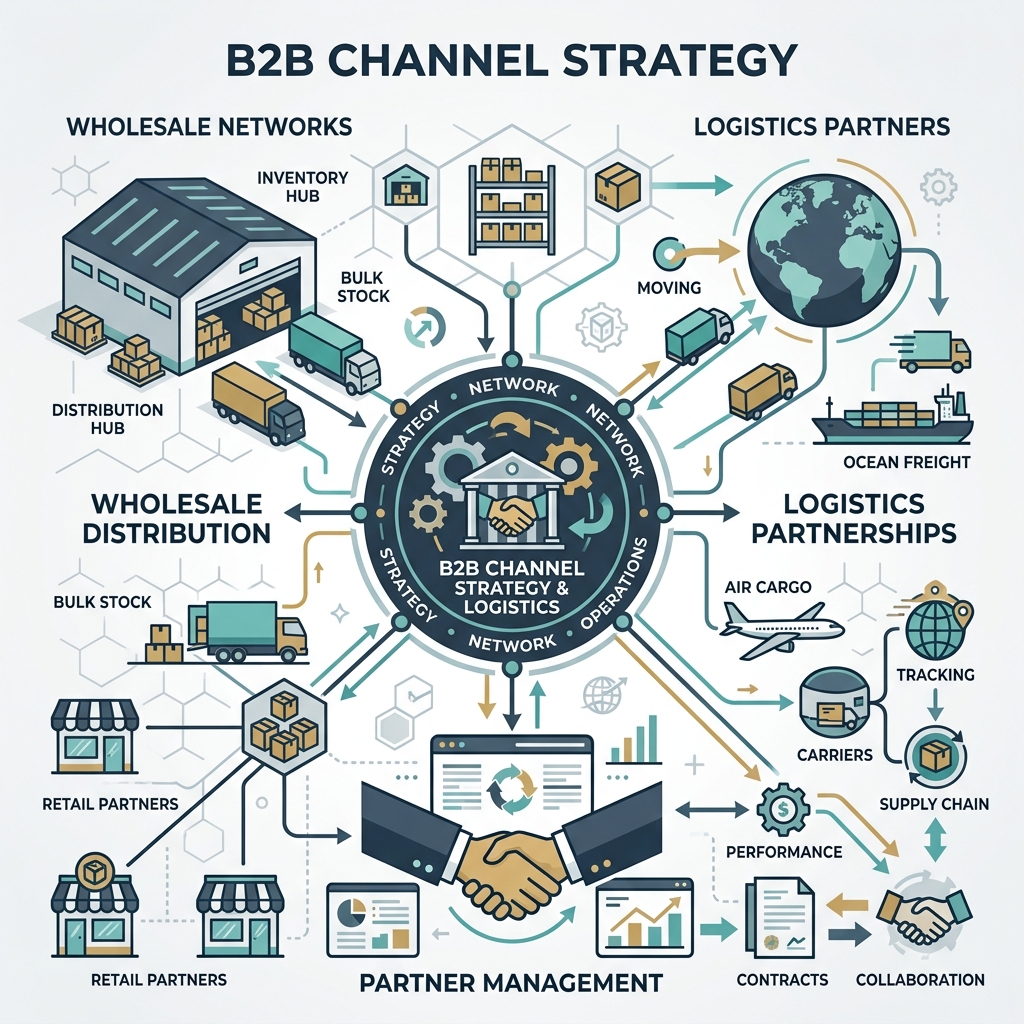
For small and mid-sized manufacturing and importing enterprises (SMEs), scaling B2B sales of physical products almost always requires partnering with third-party channels: wholesale distributors, regional dealers, and independent retail networks. Establishing a direct-to-end-user sales force is rarely cost-effective or operationally viable when trying to achieve national market coverage. Delegating logistics, localized warehousing, and relationship management to external partners is the most efficient way to expand.
However, this distribution model introduces a massive strategic risk. Many SMEs let their channel networks develop entirely organically. They sign contracts with any distributor willing to place an initial stocking order, establish ad-hoc pricing terms based on individual negotiations, and offer wide regional territories without demanding clear partner accountability. Over time, this passive approach leads to "channel decay." Distributors begin price-cutting to win the same accounts, regional coverage remains inconsistent, and you lose visibility into your end-user demand.
To establish market control and drive consistent wholesale volume, you must implement a structured, proactive B2B Channel Strategy. This strategy must focus on defining clear rules of engagement, aligning partner incentives, and maintaining strict commercial discipline. Drawing on my commercial experience directing business development and channel networks at Budmax Group, this guide outlines how mid-market B2B brands can design and manage high-yield distribution networks.
The Anatomy of Channel Conflict: Why Price Wars Develop
The most common issue in multi-channel distribution is **Channel Conflict**. This occurs when two or more of your partners—or your partner and your direct sales team—are competing for the exact same customer.
Channel conflict is almost always caused by a poorly designed commercial policy. If you sell to a national wholesale distributor, a regional dealer, and a major B2B end-user at similar discount levels, your partners will inevitably clash. The national distributor, utilizing their scale and logistics advantages, will quietly undercut the regional dealer's pricing to win local contracts. This triggers a downward spiral of price-cutting, destroying the value of your brand in the market and alienating the regional dealers who provide vital local representation and service.
"When your distributors are forced to compete on price rather than value, it is your brand that suffers. They will demand deeper discounts from you to protect their margins, and if you refuse, they will quietly deprioritize your products in favor of competitors who offer better price protection."
To prevent this conflict, you must design a structured **Commercial Policy** that categorizes your partners into distinct tiers based on their value-added functions:
- National Distributors: Partners who purchase in full-truckload volumes, hold massive inventory reserves, and distribute to smaller wholesalers. They receive your deepest functional discounts, but are strictly prohibited from selling directly to end-users or small retail accounts.
- Regional Dealers: Partners who serve specific geographic territories, offer technical installation or local support, and sell directly to local contractors or mid-market buyers. They receive moderate discounts but are protected by regional boundaries and strict pricing rules.
- Direct Accounts: Key corporate end-users managed directly by your internal sales team. These are typically limited to national accounts that require customized manufacturing or direct service level agreements.
Designing a Value-Based Commercial Policy
To maintain channel discipline, your pricing and discount structure must be based on objective, measurable value rather than negotiation skills. Too many SMEs offer deep discounts simply because a distributor's procurement manager is an aggressive negotiator. This establishes a dangerous precedent and leads to margin erosion.
Replace ad-hoc discounts with a transparent **Functional Discount Grid**. Under this system, every discount given to a distributor must correspond to a specific operational cost they assume:
- The Volume Discount: Tied strictly to annual or quarterly purchase volumes. Partners must hit predefined purchasing targets to unlock these tiers. If they miss their targets, their discount level automatically decreases in the next period.
- The Logistics Rebate: Offered to partners who purchase in optimized shipping units (e.g., full pallets or full trucks) and manage their own freight. This encourages logistics efficiency and reduces your shipping overhead.
- The Stocking Incentive: A rebate provided to dealers who maintain a predefined minimum stock level of your core SKU catalog. This ensures that when an end-user needs your product, it is locally available immediately, preventing them from switching to a competitor.
- The Marketing and Support Rebate: Offered to partners who invest in local brand promotion, participate in trade shows, or train their sales teams to support your products.
By structuring your commercial policy around functional value, you ensure that every discount is economically justified. A distributor who simply brokers orders without holding stock or providing local support should never receive the same terms as a dedicated partner who maintains inventory and represents your brand locally.
Partner Accountability: Implementing Channel KPIs
A successful B2B channel strategy requires moving from a transactional "sell-in" mindset (getting the product into the distributor's warehouse) to a collaborative "sell-through" mindset (helping the distributor sell the product to the end-user).
To manage this effectively, you must establish clear **Partner KPIs (Key Performance Indicators)** and review them during regular quarterly business updates. Do not judge a distributor solely on their total purchase volume. Monitor operational metrics that indicate the health of the channel:
- Inventory Turnover: How quickly is your product moving out of the distributor's warehouse? Slow turnover indicates that the partner is struggling to sell the inventory, which will lead to a sudden drop in future orders.
- SKU Breadth: Is the distributor actively promoting your entire product line, or are they only selling one or two low-margin commodity items? Encourage partners to carry your high-margin specialty lines by offering bundled rebates.
- Lead-Time Compliance: For partners who manage regional deliveries, monitor how quickly they fulfill orders to end-users. Late deliveries reflect poorly on your brand, even if they are caused by the distributor's logistics.
Rules of Engagement for Territory Protection
Territory protection is the cornerstone of dealer loyalty. If a regional dealer spends time and resources educating local buyers and specifying your products in local projects, they must be confident that another distributor will not quietly swoop in and steal the order at the last minute by offering a slightly lower price.
Establish a strict **Project Registration System**. Under this system, when a dealer identifies a major project and specifies your products, they register the deal with you. Once approved, that dealer is guaranteed exclusive pricing for that specific project. If another distributor requests a quote for the same project, they receive your standard list price. This protects your partner's margins, incentivizes them to invest in early-stage project specification, and prevents self-destructive price wars.
Conclusion: Strategic Channel Governance
Managing a wholesale distribution network is not a hands-off transactional process. It is a strategic governance challenge.
Define clear tiers of engagement, replace ad-hoc negotiations with a value-based commercial policy, and protect your partners' margins through project registration and geographic boundaries. When you establish strict channel discipline and actively support your partners' sell-through operations, your distribution network ceases to be a source of conflict—it becomes your most powerful tool for national B2B market expansion.