
In most small and mid-sized B2B companies, the sales team is simultaneously the most expensive commercial asset and the least systematically managed one. The typical evolution looks like this: the founder personally closes the first major contracts, then hires two or three "experienced" sales representatives, hands them a phone and a price list, and pays them a percentage of everything they sell. For the first year or two, this improvised model works. Then growth stalls, the best performer leaves and takes two key clients with them, and the owner discovers that nobody in the team can explain where next quarter's revenue will actually come from.
The root cause is rarely a lack of talent. It is the absence of a management system: no defined sales process, no measurable activity standards, and a compensation plan that rewards raw invoiced volume regardless of margin, payment discipline, or client quality. A commission-on-everything scheme feels simple and fair, but in practice it quietly trains your team to sell your cheapest products to your easiest clients at the deepest discount they can extract from you.
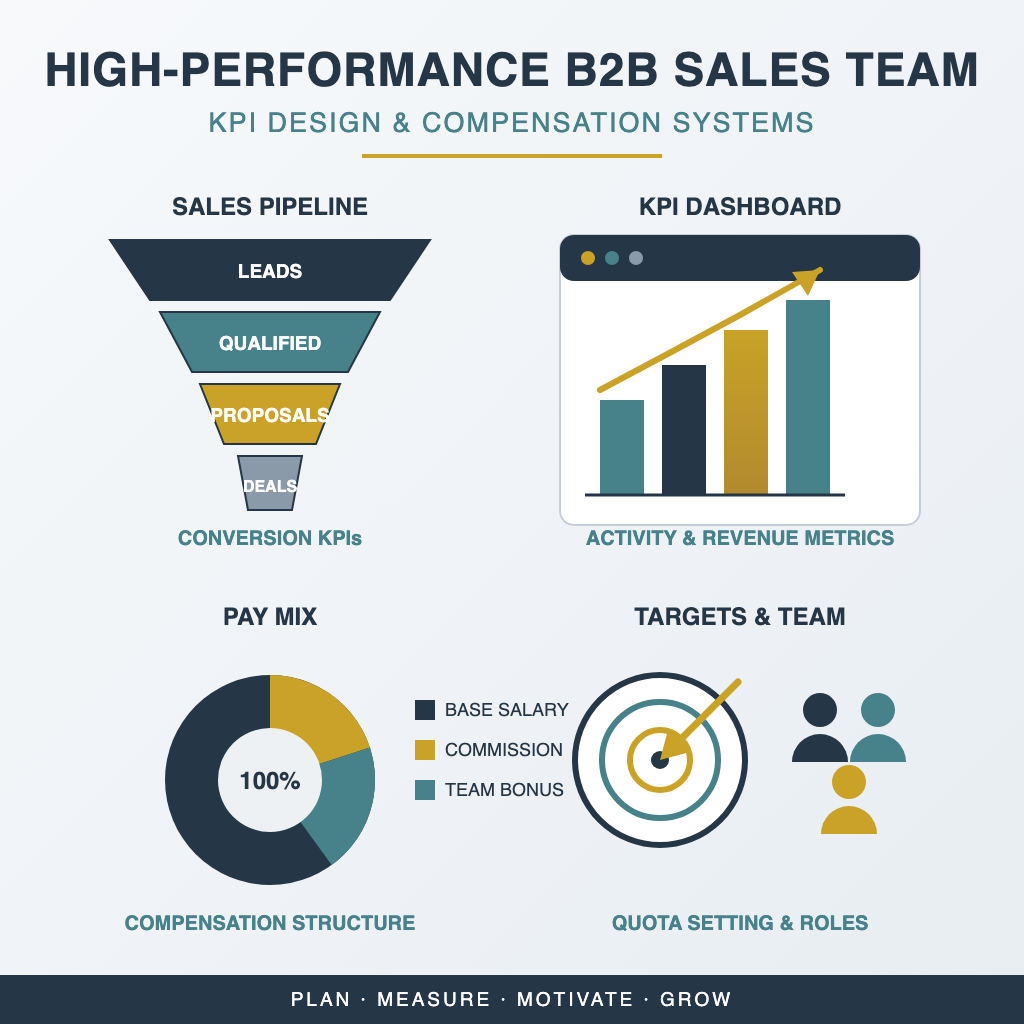
This guide describes how a mid-market B2B firm—a distributor, manufacturer, or service provider—can rebuild its sales function around three pillars: a clearly staged sales process, a compact KPI system that measures both activity and results, and a compensation structure that aligns personal earnings with company profitability. None of it requires corporate-scale CRM budgets or a dedicated sales operations department.
Start with the Process, Not the People
Before you can measure or motivate anyone, you must define what "good selling" looks like in your specific business. Map your actual sales cycle into explicit stages—for a typical B2B distributor this might be: lead identified, first contact made, needs qualified, commercial proposal sent, terms negotiated, contract signed, first order shipped, repeat order secured.
The staging matters because it converts sales from a black box into a manageable pipeline. When you know that historically one contract emerges from every five proposals, and one proposal from every three qualified conversations, you can work backwards from your revenue target to the weekly activity volume each salesperson must sustain. Revenue becomes an output you can engineer, not a lottery you hope to win.
"You cannot manage a result. You can only manage the activities and conversion rates that produce the result. If your only sales metric is monthly revenue, you are reading yesterday's newspaper and calling it navigation."
Defining the process also exposes structural role confusion. In many SMEs, the same person hunts for new clients, services existing accounts, chases overdue invoices, and handles logistics complaints. These activities require different temperaments and compete for the same working hours—and account maintenance always wins, because it is more comfortable than cold outreach. Even with a team of four or five people, it usually pays to separate new-business development from existing account management, at least partially.
Designing the KPI System: Few, Balanced, and Non-Negotiable
The most common KPI mistake in mid-sized companies is not the absence of metrics but their inflation. A salesperson given fifteen KPIs effectively has none, because no single metric carries enough weight to change behavior. A practical system needs five to seven indicators at most, split across three layers:
- Result KPIs: Revenue against plan, gross margin against plan, and share of overdue receivables. Margin must stand next to revenue, otherwise your team will buy volume with your profit. Receivables must be included, because a sale is not complete until the money arrives.
- Activity KPIs: The controllable inputs—qualified meetings held, proposals issued, new accounts opened, dormant clients reactivated. These are the early-warning system: activity collapses six to eight weeks before revenue does.
- Quality KPIs: Pipeline data completeness in your CRM, forecast accuracy, and adherence to pricing policy. These protect the long-term manageability of the commercial function.
Set targets from your own historical data, not from industry folklore. Take six months of records, calculate the real conversion rates and the real activity levels of your better performers, and set the initial standards slightly above the current average. A target that the team perceives as arbitrary or unreachable does not motivate—it delegitimizes the entire system.
Review the numbers on a fixed weekly rhythm: a short pipeline meeting where each salesperson reports deals moved between stages, not stories about the market. The discipline of the cadence matters more than the sophistication of the dashboard. A whiteboard reviewed every Monday beats a business-intelligence suite reviewed once a quarter.
Compensation: Paying for Profit, Not for Turnover
Compensation is where sales strategy becomes real. Whatever your strategy documents say, your team will do what the pay plan rewards. A robust SME structure has three components:
- Base salary (roughly 40–60% of target earnings): High enough that a professional can survive a weak quarter without panicking, low enough that nobody can coast on it. Extremely low bases feel cheap but select for desperate candidates and drive churn of exactly the people you want to keep.
- Variable bonus tied to margin and collection (30–50%): Pay the percentage on collected gross margin, or on revenue weighted by the discount given. The moment a salesperson's personal income drops when they give away an extra five percent discount, your pricing policy starts enforcing itself. Paying only after the client's money arrives makes your sales force the most motivated receivables department you will ever have.
- Targeted incentives (5–15%): Quarterly bonuses for strategic priorities that pure margin math does not capture—launching a new product line, opening a target region, or winning named competitor accounts. Rotate these deliberately; a permanent bonus stops being an incentive and becomes an entitlement.
Two design rules prevent the most common failures. First, the plan must fit on one page and be calculable by the salesperson themselves in five minutes; if people cannot predict their own payout, the motivational effect evaporates. Second, never change the rules retroactively or cap earnings mid-period. One episode of "we recalculated your bonus because it came out too high" destroys years of trust and guarantees your best closers will start interviewing.
The Manager's Rhythm: Coaching Over Controlling
KPI dashboards and bonus grids do not manage people—managers do. The head of sales in an SME should spend at least a third of their time in the field or on joint calls, not consolidating reports. A simple monthly rhythm works: one individual review per salesperson focused on their pipeline and skill gaps, one joint client visit to observe them in action, and one team session to dissect a won and a lost deal.
Treat lost-deal analysis as seriously as won-deal celebration. The pattern of losses—always on price, always at the proposal stage, always against the same competitor—tells you precisely whether your problem is positioning, pricing, or skills. This information is free, and almost nobody collects it systematically.
Implementation: The 90-Day Transition
Do not switch systems overnight. A practical rollout takes one quarter: in the first month, define the process stages and start measuring current activity without any consequences attached. In the second, agree individual targets with each salesperson and run the new bonus calculation in parallel with the old one, showing everyone both numbers. In the third, switch payment to the new scheme, ideally with a temporary guarantee that nobody earns less than their previous average during the transition.
Expect resistance from exactly two groups: genuinely weak performers whose comfort depended on opacity, and strong performers who fear the change is a disguised pay cut. The first group's resistance is a feature of the system, not a bug. The second group deserves individual conversations with the actual math—shown honestly, a margin-based plan almost always pays a strong performer more, not less.
Conclusion: A System That Outlives Any Individual
The purpose of KPI and compensation design is not bureaucratic control. It is to make commercial success repeatable and independent of any single hero salesperson—including the founder. When the sales process is explicit, activity is visible weeks before results, and personal earnings rise and fall with company profit, you no longer manage by anecdote and intuition.
Start small: map your stages, pick five metrics, and put margin next to revenue in the bonus formula. Within two quarters you will know more about your commercial engine than years of raw revenue reports ever told you—and your best people will finally be paid for the value they truly create.