
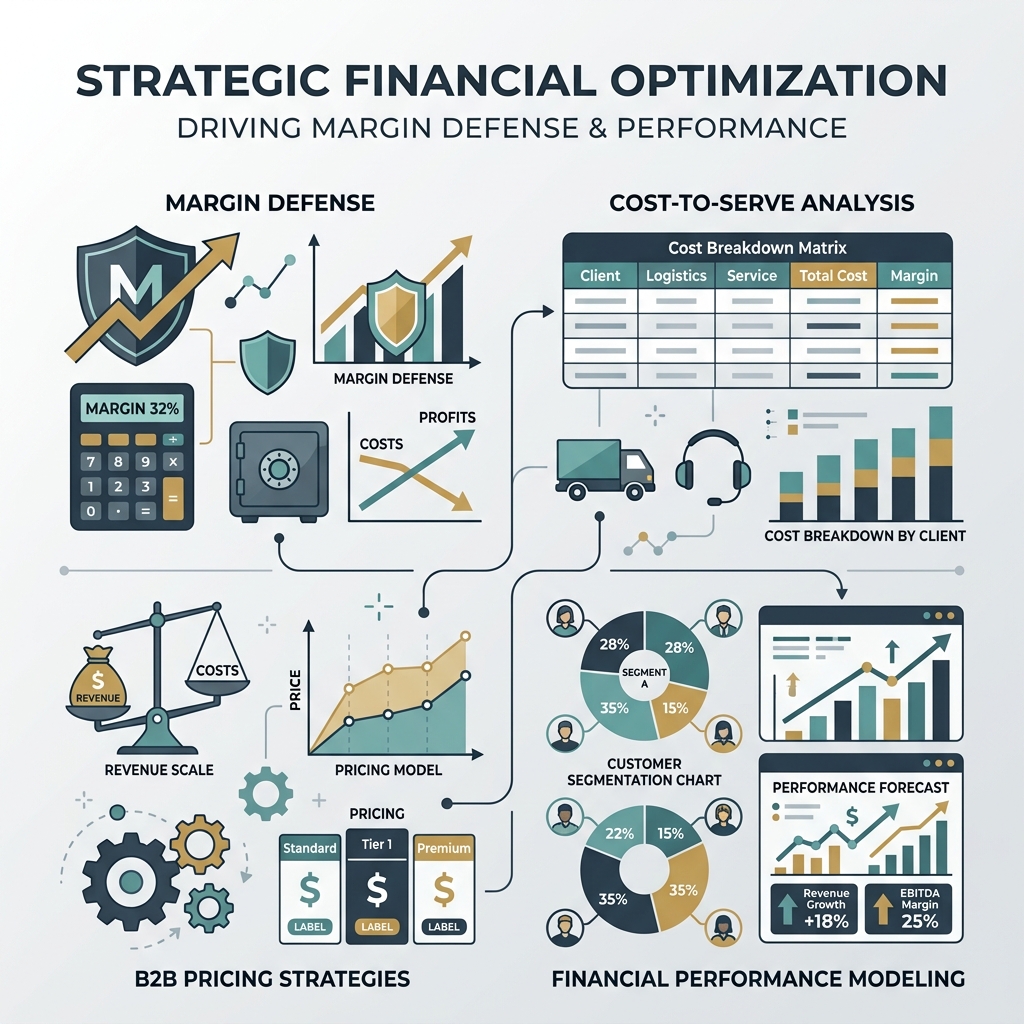
In the daily management of mid-sized B2B manufacturing, distribution, and services businesses, gross margin is the ultimate indicator of health. However, in highly volatile or inflationary environments—such as the B2B landscape in Ukraine—defending this margin is an ongoing challenge. Raw material costs spike without warning, fuel prices fluctuate, logistics routing becomes complex, and currency fluctuations quietly erode your bottom line.
Under these pressures, many SMEs fall into a dangerous trap: they focus entirely on top-line revenue growth. They assume that as long as sales volumes are increasing, the business remains profitable. Sales managers are incentivized to close every possible deal, often offering custom discounts, free shipping, split-deliveries, or customized packaging to win accounts. The result is a common commercial paradox: **revenue is growing, but cash flow is shrinking, and net profitability is disappearing.**
The root cause of this paradox is that B2B companies rarely calculate their true **Cost-to-Serve (CTS)** per customer segment. They apply a flat, average operating expense percentage across all accounts, failing to realize that some clients are highly profitable, while others quietly drain cash flow through customized operational demands. To protect your liquidity, you must implement a structured margin defense framework based on granular CTS analysis and dynamic B2B pricing models.
The Concept of Cost-to-Serve (CTS): Not All Revenue is Equal
To build a resilient pricing structure, you must look beyond basic gross margin (Price minus Cost of Goods Sold) and analyze the total operational cost of delivering your product to each specific client. This is the core of Cost-to-Serve analysis.
Consider two wholesale distributors who purchase the exact same volume of building materials or logistics services from you:
- Customer A: Places a single, monthly bulk order of standard SKUs, accepts full-pallet delivery at their main warehouse, pays within terms, and uses your standard digital ordering portal. The operational cost to serve Customer A is extremely low.
- Customer B: Places small, urgent orders three times a week, demands split-shipments directly to local job sites, requires customized label sorting on every pallet, calls your sales team daily to request delivery updates, and routinely delays payments. The operational cost to serve Customer B is massive.
If both Customer A and Customer B receive the same standard wholesale discount based solely on their total volume, Customer B is quietly draining your profitability. In fact, when you factor in the additional warehouse labor, split freight costs, administrative sales time, and financing costs of delayed payments, Customer B may be completely unprofitable. You are effectively subsidizing Customer B's operations using the profit generated by Customer A.
Mapping Cost-to-Serve Drivers
To identify where your margins are eroding, you must map out and allocate indirect operational costs to specific client accounts. This does not require complex corporate accounting software; a simple, structured spreadsheet mapping four key cost drivers is highly effective:
- Order Frequency and Size: Small, frequent orders require significantly more administrative and warehouse picking labor per unit sold than large, consolidated orders. Calculate the average cost of processing and picking a single order, and identify accounts with low average order values (AOV).
- Logistics and Freight: Group customers by their delivery requirements. Are you paying for split-deliveries, regional tail-lift unloading, or emergency express courier shipments? Track actual freight costs per account.
- Packaging and Product Customization: Calculate the cost of customized labels, specific sorting rules, or repacking items. These manual steps slow down warehouse throughput and increase packaging costs.
- Payment Terms and Days Sales Outstanding (DSO): In B2B sales, terms are a financing service. A client who takes 45 days to pay is significantly more expensive to serve than one who pays on delivery, especially in high-inflation environments where cash today is worth more than cash next month.
"When you calculate the actual freight, warehouse labor, and payment financing costs for each account, you will find that a significant portion of your B2B portfolio is either marginal or actively losing money. Your goal is not to fire these clients immediately, but to restructure their commercial terms to make them profitable."
Restructuring Commercial Terms: The Profitability Matrix
Once you have calculated the CTS and revenue for each account, plot your B2B portfolio onto a simple **Profitability Matrix** with four quadrants:
- High Revenue / Low Cost-to-Serve (The Core): These are your most valuable, highly profitable accounts. They require strategic defense. Ensure they receive top-tier service, regular strategic review meetings, and loyalty incentives to prevent competitor encroachment.
- Low Revenue / Low Cost-to-Serve (The Baseline): Standard accounts that require minimal support. Keep their management highly automated using standard digital ordering systems and fixed delivery routes.
- High Revenue / High Cost-to-Serve (The Renegotiation): Large accounts that generate significant volume but drain your margins through custom operational demands. These accounts require active intervention. Meet with their operations team to restructure terms: implement minimum order quantities (MOQs), establish a standard weekly delivery schedule instead of split-shipments, or charge a premium for custom packaging.
- Low Revenue / High Cost-to-Serve (The Drain): Small accounts that demand significant custom service. These must be aggressively optimized: move them to a strictly distributor-managed channel, cut custom delivery services, or increase their pricing to cover the actual cost of serving them. If they reject these terms, letting them go to a competitor will actually increase your net profitability.
Implementing Dynamic Pricing in Volatile B2B Markets
In volatile B2B markets, setting rigid yearly prices is a high-risk commercial strategy. By the time you notice raw material cost increases, weeks of sales may have already occurred at zero margin.
To defend margins, B2B brands must transition to **Dynamic Pricing Models**:
- Index-Linked Surcharges: Link a portion of your pricing to objective, external market indexes. For example, if you operate a manufacturing or distribution business, implement a transparent fuel or raw material surcharge that adjusts automatically on a monthly basis based on independent commodity pricing.
- Exchange-Rate Pegging: For imported components or materials, peg your B2B pricing grid to the current exchange rate, with a buffer threshold. If the currency fluctuates by more than 3% to 5%, your pricing automatically adjusts in the next billing cycle.
- Cost-to-Serve Add-Ons: Charge separately for premium operational services. Instead of offering "free shipping on all B2B orders," make shipping free only above a specific AOV threshold. Charge separate, transparent fees for split-deliveries, rush shipping, or custom labeling. This incentivizes clients to adjust their ordering habits to save money, which directly reduces your operational complexity.
Conclusion: Continuous Margin Vigilance
Gross margins do not defend themselves. They require continuous commercial vigilance, a deep understanding of your operational cost drivers, and the discipline to renegotiate terms with unprofitable accounts.
Stop focusing solely on top-line revenue. Implement a clear Cost-to-Serve model, map out your customer profitability matrix, and transition to dynamic, value-based pricing. When you align your pricing structure with the actual cost of delivery, you secure your cash flow, protect your margins, and build a resilient B2B enterprise capable of thriving in any market conditions.