
There is a paradox that almost every owner of a growing trading or distribution business eventually encounters: the profit and loss statement shows a healthy margin, sales are rising quarter after quarter, and yet the company is permanently short of cash. Salaries are paid from the overdraft, suppliers are asked to wait "just one more week," and every large incoming order triggers not celebration but a scramble for financing. The business is profitable on paper and starving in reality.
The explanation is nearly always the same: growth consumes working capital faster than profit replenishes it. Every additional pallet on the warehouse shelf and every invoice awaiting payment is your money—already spent, not yet returned. In distribution businesses, inventory and receivables routinely tie up two or three times more cash than all fixed assets combined. Yet while every SME owner scrutinizes the P&L monthly, very few systematically manage the balance sheet items where their liquidity actually lives.
This article lays out a practical framework for freeing that trapped cash: measuring your cash conversion cycle, imposing discipline on inventory through ABC analysis, professionalizing receivables management, and negotiating supplier terms as deliberately as you negotiate sales prices. No refinancing, no new credit lines—just recovering the capital already sitting inside your own operation.
Measure First: The Cash Conversion Cycle
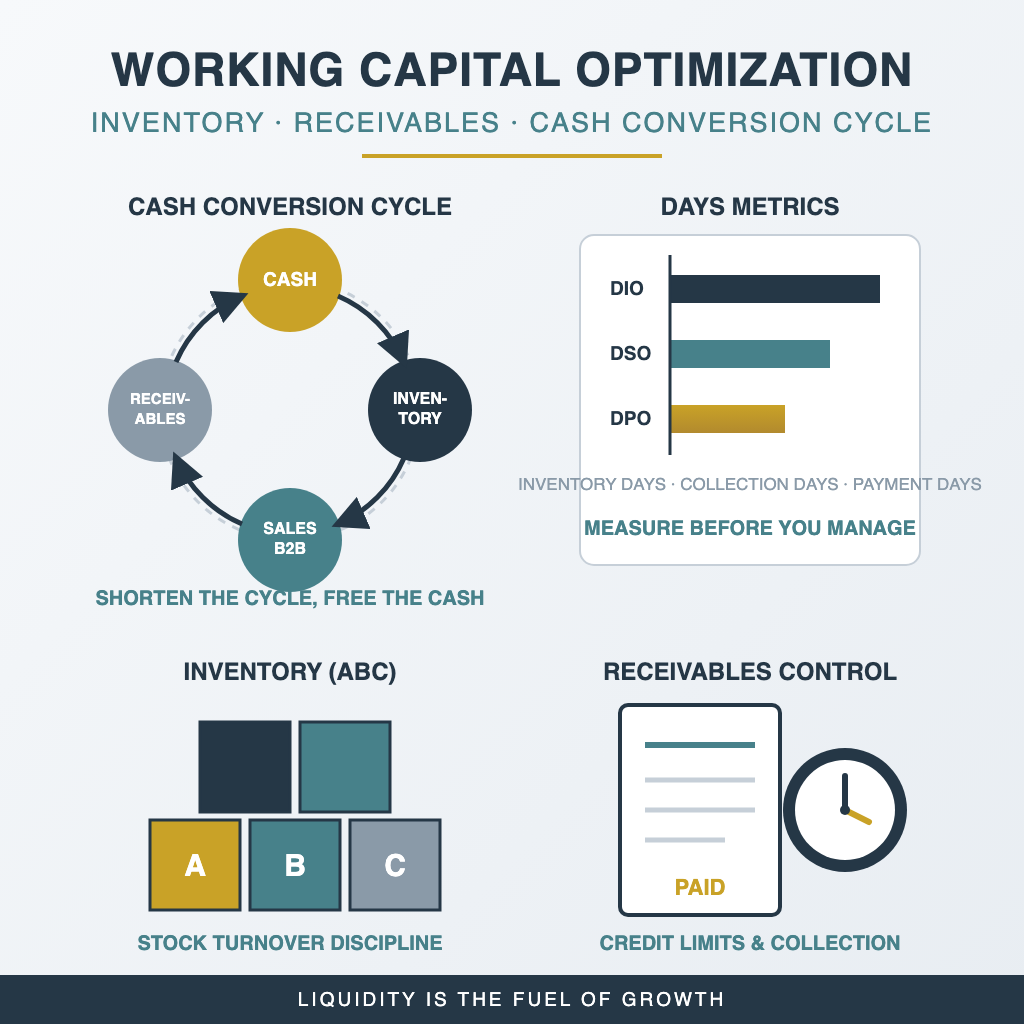
The single most useful liquidity metric for a trading SME is the **Cash Conversion Cycle (CCC)**—the number of days between paying your supplier for goods and receiving payment from your customer for those same goods. It is built from three components: Days Inventory Outstanding (how long stock sits in your warehouse), Days Sales Outstanding (how long clients take to pay you), and Days Payable Outstanding (how long you take to pay suppliers). The cycle equals DIO plus DSO minus DPO.
Suppose your goods sit in stock for 60 days on average, your B2B clients pay in 45 days, and your suppliers give you 30 days of credit. Your cycle is 75 days: for two and a half months, every hryvnia of turnover is financed out of your own pocket. Now the arithmetic of growth becomes visible—if you plan to increase sales by 40% next year, you must find financing for 40% more working capital, or shorten the cycle. Shortening it is usually far cheaper.
"Every day you cut from your cash conversion cycle is a permanent, interest-free loan issued to you by your own operational discipline. A distributor turning over the equivalent of $500,000 a month frees roughly $16,000 of cash for every single day removed from the cycle."
Calculate the three components from data you already have in your accounting system, and track them monthly alongside revenue and margin. What gets measured monthly gets managed; what gets discovered during a cash crisis gets firefought.
Inventory: Where Cash Goes to Sleep
Warehouses accumulate cash the way attics accumulate boxes—gradually, invisibly, and with the best intentions. Purchasing managers over-order to avoid the unpleasant conversation about stockouts; nobody is ever reprimanded for excess inventory, because excess is silent. The correction starts with a simple **ABC analysis** of your assortment by margin contribution and turnover speed.
- A-items (typically ~20% of SKUs, ~80% of margin): These deserve real availability targets, safety stock, and weekly attention. A stockout here costs you clients; this is the only category where holding extra inventory is a defensible investment.
- B-items (the middle ~30%): Order against actual consumption with modest buffers. Review monthly, not weekly.
- C-items (the long tail, half your SKU list, a sliver of your margin): Minimize or move to under-order. Much of the C-category exists because "a client once asked for it in 2022." Every C-pallet occupies space, absorbs handling labor, and freezes cash that your A-items could be multiplying.
Then confront the dead stock honestly: anything without movement for six to twelve months. The purchase money is already lost—refusing to discount obsolete goods does not preserve value, it preserves the illusion of value on your balance sheet while the goods quietly expire, go out of fashion, or get damaged. Sell it at whatever the market pays, convert it back into cash, and put that cash into fast-turning stock. And treat the root cause: give your purchasing function a maximum stock-cover KPI (e.g., no more than X weeks of forward consumption per SKU), not just a "no stockouts" KPI.
Receivables: A Sale Is Not Complete Until the Money Arrives
In B2B trade, deferred payment is a competitive necessity—but uncontrolled deferred payment is an unsecured, interest-free loan portfolio run by your most optimistic employees. Professionalizing it does not require a credit department; it requires four rules applied without exceptions:
- Credit limits for every client, set before the first deferred shipment. Base them on payment history, order volume, and public registry data. New clients start with prepayment or small limits and earn more; nobody receives open credit because "they seem like a serious company."
- An aging report reviewed every week. Receivables must be visible in buckets—current, 1–15 days overdue, 16–30, over 30—and each bucket must have a named owner and a scripted action: reminder before the due date, call on day one of delay, shipment stop at a defined threshold. The most expensive words in receivables management are "let's not pressure them, they always pay eventually."
- Shipment blocks that trigger automatically. If a client exceeds their limit or their overdue threshold, new shipments stop without requiring anyone's courage. Discipline that depends on a manager's willingness to have an awkward conversation is not discipline.
- Sales compensation tied to collected money. As long as your salespeople are paid on shipped volume, they will lobby against every credit rule you write. Pay bonuses on collected margin, and your sales force becomes your first line of credit control.
For clients who chronically pay late but remain commercially valuable, price the credit explicitly: offer a small discount for prepayment or shorter terms, and build the cost of long terms into their pricing. Deferred payment is a service with a real cost—stop giving it away for free.
Payables: The Cheapest Financing You Will Ever Get
The third lever is the one SMEs use least deliberately: supplier terms. Payment terms deserve the same negotiation energy as purchase prices, because thirty extra days of supplier credit finances your entire cycle at zero interest. Consolidate volumes with fewer key suppliers to increase your negotiating weight, offer predictable ordering schedules in exchange for longer terms, and—critically—always compare early-payment discounts against your real cost of money. A 2% discount for paying 30 days early is an annualized return of roughly 24%; if you are simultaneously drawing an overdraft at 20%, taking that discount with borrowed money still wins. Do this arithmetic explicitly for every major supplier instead of letting habit decide.
One warning: never stretch payables by simply paying late without agreement. Negotiated terms are financing; unilateral delays are reputation damage that eventually costs you priority during shortages, allocation in high season, and every future concession.
Making It Stick: The Weekly Cash Rhythm
None of these mechanisms survive as one-off cleanup campaigns. Embed them in a weekly operating rhythm: a thirty-minute review of the 13-week rolling cash forecast, the receivables aging report, incoming purchase commitments, and the top inventory outliers. Assign each of the three cycle components a single accountable owner—purchasing for DIO, sales and finance jointly for DSO, finance for DPO—and put their targets into the same bonus system that drives revenue.
The 13-week horizon matters: it is long enough to see a seasonal cash gap coming while there is still time to act—slow purchasing, accelerate collections, arrange financing on your terms rather than in panic—and short enough to stay concrete, week by week, invoice by invoice.
Conclusion: Liquidity Is a Management Discipline, Not a Financing Problem
When cash is short, the reflex of most SME owners is to look outward—for a bigger credit line, an investor, a factoring arrangement. Sometimes external financing is genuinely needed. But in the majority of trading and distribution businesses I have seen, one to two months' worth of revenue is lying frozen in excess stock and overdue invoices, waiting to be recovered by nothing more sophisticated than measurement, rules, and a weekly rhythm.
Start with the number: calculate your cash conversion cycle this week. Then attack its largest component first. The cash you free is not only cheaper than any loan—it is capital that arrives with better habits attached, because the discipline that recovered it is the same discipline that will keep your growth funded from within.